Common Name
Cypress firefly, Wall Doxey's firefly
Scientific Name
Photuris walldoxeyi
Recent Synonyms
None
Adult Male Size
11.9-12.6 mm
Diet
Snails, slugs, worms, and other soft-bodied invertebrates
Firefly Atlas Category
Focal species
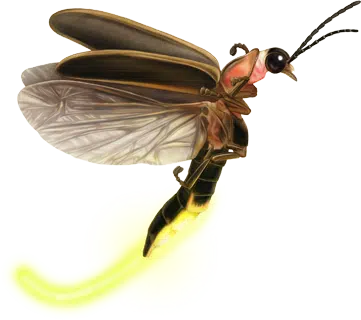
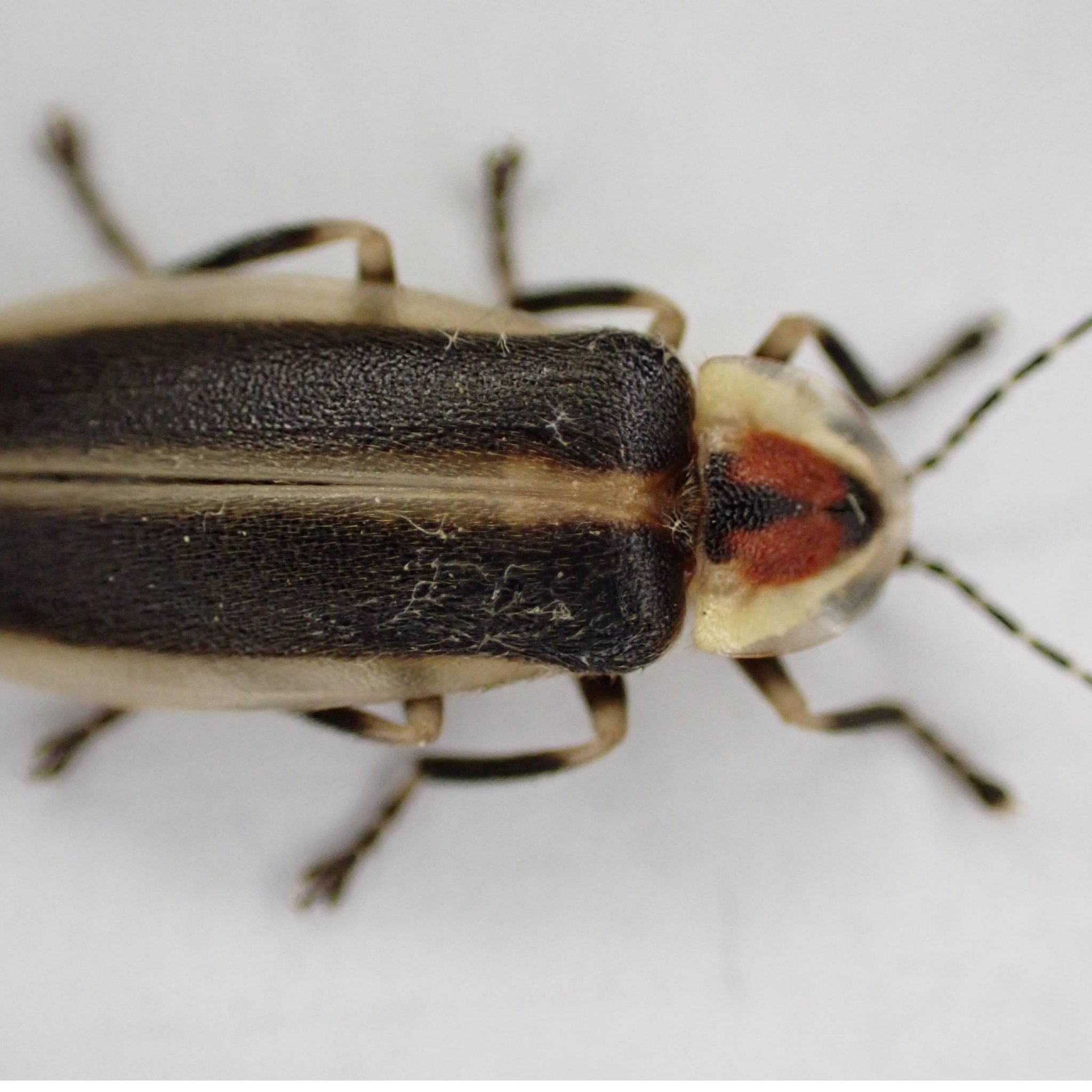
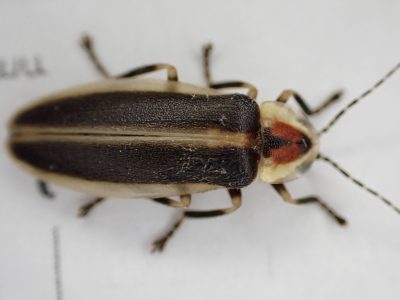
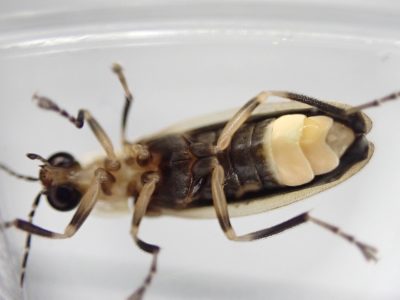
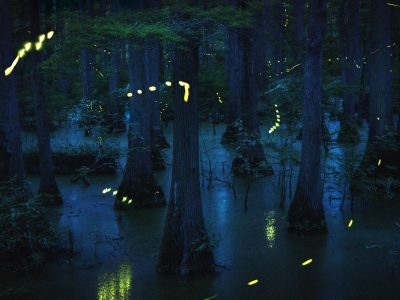
True to its name, the cypress firefly is a habitat specialist associated with cypress and tupelo swamps. It has so far only been found in drainages that feed into the Mississippi River. Males of this species display a unique flash pattern as they fly over swamps and ponds that remain wet year-round. Habitat loss and light pollution are the primary threats to this species. Known locations are patchily scattered from Indiana to Mississippi. It is likely more populations exist but have yet to be documented.
Conservation
Reason(s) For Firefly Atlas Focal Species Designation
Reliably identifiable, Suspected population loss
Status
IUCN Red List
The International Union for Conservation of Nature (IUCN) Red List of Threatened Species is an inventory of the global conservation status and extinction risk of biological species, maintained collectively by scientists worldwide.Vulnerable (VU)
NatureServe
The NatureServe conservation status ranks use a standardized methodology to assess the extinction risk of species, with a focus on the US and Canada. State wildlife agencies and natural heritage programs use these ranks to prioritize species for conservation actions.Globally imperiled to vulnerable (G2G3) Critically imperiled in Arkansas (S1) State rank not yet assessed in Illinois, Mississippi, Tennessee (SNR) State rank currently unrankable in Indiana due to lack of information or due to substantially conflicting information about status or trends (SU)
Species of Greatest Conservation Need Lists
Species of Greatest Conservation Need (SGCN) are lists of species included in State Wildlife Action Plans, identifying animals and plants that need the most conservation attention and resources at the state and region level.Arkansas
US Endangered Species Act
The Endangered Species Act is a United States law that provides legal protections to species that are officially listed as endangered or threatened by the US Fish and Wildlife Service.N/A
Threats
The main threats to this species are habitat loss and degradation and light pollution.
Location
Distribution
USA
Arkansas, Illinois, Indiana, Mississippi, Tennessee
Details
The cypress firefly has been found in isolated locations scattered across Illinois, Indiana, Tennessee, Mississippi, and Arkansas. The most recent populations have been discovered in Arkansas, where it is now recorded from Goose Pond Natural Area and a site in Little Rock in Pope and Conway Counties and Pulaski County, respectively. In Mississippi, it has been recorded in Madison, Marshall, and Desoto Counties, at four different sites, including one in Wall Doxey State Park. In Tennessee it is known from four sites, two in Fayette County (one in the Ghost River State Natural Area and one in the William B. Clark Conservation Area), one in Madison County, and one in Obion County. In Indiana it is known from Posey and Monroe Counties at the Twin Swamps Nature Preserve and the Bean Blossom Nature Preserve, respectively. In Illinois, it has been recorded in Johnson County at the Heron Pond-Little Black Slough Nature Preserve in the Cache River and Cypress Creek Wetlands. All known sites are within watersheds that ultimately drain into the Mississippi River.
Habitat
The cypress firefly is a habitat specialist associated with cypress and tupelo gum swamps.


Behavior
Activity Period
Adults are active after dark from mid-May to mid-June, typically emerging 45 minutes after sunset.
Flash Pattern
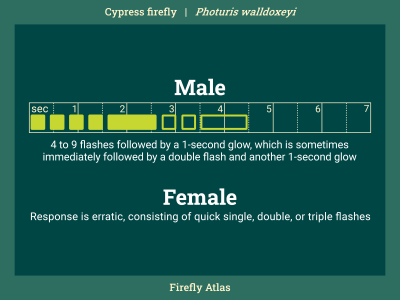
This species has a unique courtship flash pattern consisting of four to nine bright pulsing green-yellow flashes, followed by a prolonged one-second glow. This prolonged glow is sometimes immediately followed by another double flash and one-second prolonged glow. The female response is erratic, consisting of quick single, double, or triple flashes.
Sources
Faust, L. and A. Walker. 2021. Photuris walldoxeyi. The IUCN Red List of Threatened Species 2021: e.T164045636A166771468. https://dx.doi.org/10.2305/IUCN.UK.2021-1.RLTS.T164045636A166771468.en. Accessed on 25 September 2025.
Faust, L. and A. Walker. 2021. Photuris walldoxeyi. NatureServe Explorer. https://explorer.natureserve.org/Taxon/ELEMENT_GLOBAL.2.1102822/Photuris_walldoxeyi. Accessed on 25 September 2025.