Black firefly

Common Name

Black firefly, woodland lucy

Scientific Name

Lucidota atra

Recent Synonyms

None

Adult Male Size

9-11 mm

Diet

Soft-bodied invertebrates

Firefly Atlas Category

Common species
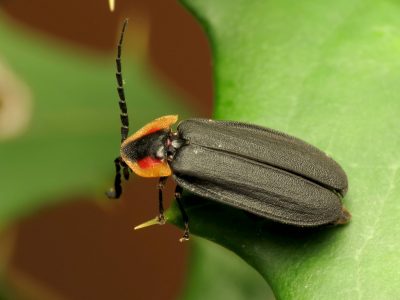
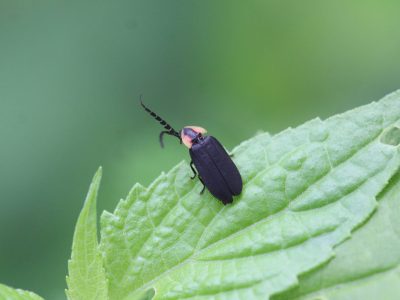
The woodland lucy is a diurnal (day active) firefly found in forests and other shady habitats across eastern North America.
  • A black firefly perches on the edge of a leaf.
  • A black firefly perches on the edge of a leaf.

Identifying Features

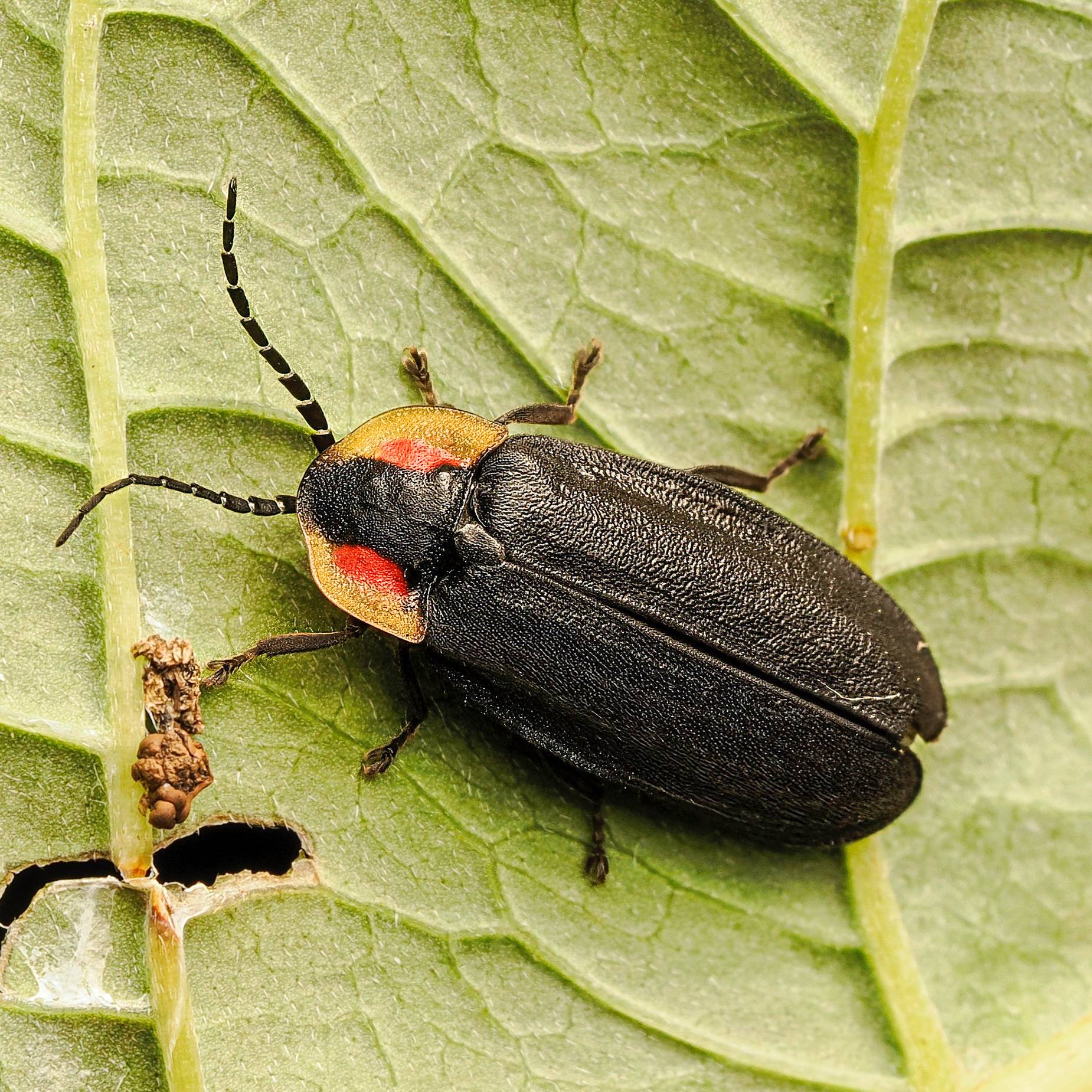
Small to medium dark firefly with exceptionally long, flattened, segmented antennae. Adults are non-luminous although may retain rudimentary, nonfunctioning lanterns. Both males and females are winged. The pronotum (head shield) markings vary from black to black with red patches.

Conservation

Status

IUCN Red List

The International Union for Conservation of Nature (IUCN) Red List of Threatened Species is an inventory of the global conservation status and extinction risk of biological species, maintained collectively by scientists worldwide.

Least Concern (LC)

NatureServe

The NatureServe conservation status ranks use a standardized methodology to assess the extinction risk of species, with a focus on the US and Canada. State wildlife agencies and natural heritage programs use these ranks to prioritize species for conservation actions.

Globally secure (G5) State rank not yet assessed in Alabama, Arkansas, Connecticut, Delaware, Georgia, Illinois, Indiana, Iowa, Kansas, Kentucky, Louisiana, Maine, Maryland, Massachusetts, Michigan, Minnesota, Mississippi, Missouri, Nebraska, New Hampshire, New York, North Carolina, Ohio, Oklahoma, Pennsylvania, Rhode Island, Tennessee, Texas, Vermont, Virginia, Wisconsin (SNR) Imperiled to apparently secure in Florida (S2S4) Apparently secure to secure in South Carolina (S4S5) Secure in West Virginia (S5)

Species of Greatest Conservation Need Lists

Species of Greatest Conservation Need (SGCN) are lists of species included in State Wildlife Action Plans, identifying animals and plants that need the most conservation attention and resources at the state and region level.

None

US Endangered Species Act

The Endangered Species Act is a United States law that provides legal protections to species that are officially listed as endangered or threatened by the US Fish and Wildlife Service.

N/A

Threats

Specific threats to the woodland lucy have not been reported. However, like other fireflies, this species may be affected by habitat loss and degradation, pesticide use, and climate change.

Location

Distribution

USA

Alabama, Arkansas, Connecticut, Delaware, Florida, Georgia, Iowa, Illinois, Indiana, Kansas, Kentucky, Louisiana, Massachusetts, Maryland, Maine, Michigan, Minnesota, Missouri, Mississippi, North Carolina, Nebraska, New Hampshire, New York, Ohio, Oklahoma, Pennsylvania, Rhode Island, South Carolina, Tennessee, Texas, Virginia, Vermont, Wisconsin, West Virginia

Canada

Manitoba, New Brunswick, Nova Scotia, Ontario, Quebec, Prince Edward Island

Details

Woodland lucies are broadly distributed across eastern North America, from Florida north into several Canadian provinces and west to Nebraska and Kansas.

Habitat

This firefly is found throughout a range of forested and shady open habitats.

Behavior

Activity Period

Adults are active from late May through July, depending on the location. During peak activity periods, often in mid-June, several hundred males can be seen in one day. Adults tend to be most active in late morning to early afternoon.

Flash Pattern

Adults do not flash but instead utilize pheromones to attract mates.

Sources

Fallon, C. 2021. NatureServe Explorer: Lucidota atra. Available from https://explorer.natureserve.org/Taxon/ELEMENT_GLOBAL.2.747308/Lucidota_atra. Accessed on 15 September 2025. Fallon, C. 2021. Lucidota atra. The IUCN Red List of Threatened Species 2021: e.T164015516A166771328. https://dx.doi.org/10.2305/IUCN.UK.2021-1.RLTS.T164015516A166771328.en. Accessed on 15 September 2025. Faust, L.F. 2017. Fireflies, Glow-worms, and Lightning Bugs. Identification and Natural History of the Fireflies of the Eastern and Central United States and Canada. University of Georgia Press. Athens, GA. 356 pp.

Last Updated

Connect

Sign up for our newsletter to receive updates.

Follow

Follow the Xerces Society.

Share

Share this page.

Support

Support the Xerces Society's conservation work.

This is a project of the Xerces Society, working in collaboration with the IUCN SSC Firefly Specialist Group and New Mexico BioPark Society.

Copyright © 2026 The Xerces Society •1631 NE Broadway Street, #821 • Portland OR 97232 USA
Firefly logo by Ink Dwell studio; © 2020 Jane Kim