Snails, slugs, worms, and other soft-bodied invertebrates
Firefly Atlas Category
Common species
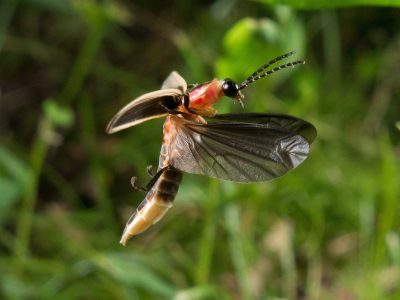
Active at dusk on summer evenings, the big dipper firefly is one of the most commonly encountered and best known fireflies in eastern North America. Adult males produce a characteristic yellow J-shaped flash, moving through open areas including parks, yards, fields, and meadows as they search for females. These are typically the largest and most abundant fireflies seen in the summer and are the target of many a gleeful child out catching lightning bugs.
✕
Identifying Features
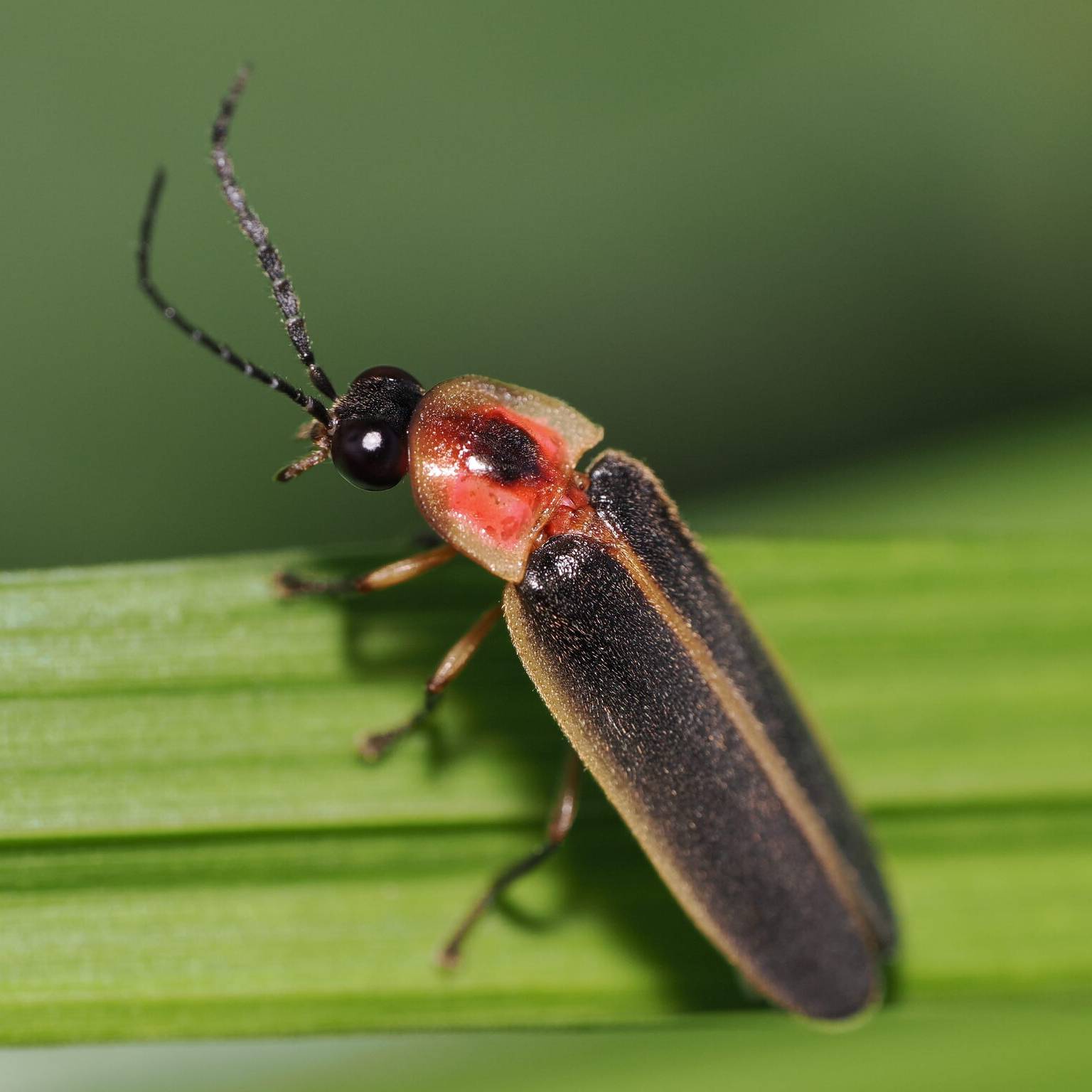
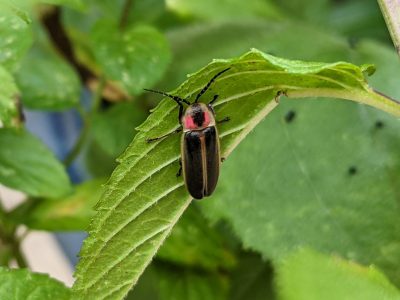
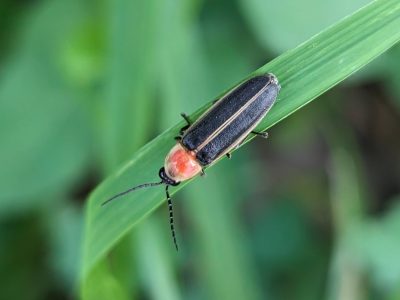
Relatively large for a Photinus. Males give off a long, yellow, J-shaped flash every five to seven seconds. Big dipper fireflies have prominent dark spots on their pronota (head shields) surrounded by bright pink or red markings. Both males and females are winged and have lanterns.
The NatureServe conservation status ranks use a standardized methodology to assess the extinction risk of species, with a focus on the US and Canada. State wildlife agencies and natural heritage programs use these ranks to prioritize species for conservation actions.
Globally secure (G5)
Secure in West Virginia (S5)
Apparently secure to secure in South Carolina (S4S5)
State rank not yet assessed in Alabama, Arkansas, Connecticut, Delaware, District of Columbia, Florida, Georgia, Illinois, Indiana, Iowa, Kansas, Kentucky, Louisiana, Maryland, Michigan, Minnesota, Mississippi, Missouri, Nebraska, New Jersey, New Mexico, New York, North Carolina, Ohio, Oklahoma, Pennsylvania, Rhode Island, South Dakota, Tennessee, Texas, Virginia, and Wisconsin (SNR)
Possibly extinct in Arizona and Colorado (SH)
Species of Greatest Conservation Need Lists
Species of Greatest Conservation Need (SGCN) are lists of species included in State Wildlife Action Plans, identifying animals and plants that need the most conservation attention and resources at the state and region level.
None
US Endangered Species Act
The Endangered Species Act is a United States law that provides legal protections to species that are officially listed as endangered or threatened by the US Fish and Wildlife Service.
N/A
Threats
Threats to the big dipper firefly are not well documented. There are probably localized threats that vary across the range of this species. Due to its occurrence in numerous unnatural habitats, this species seems less susceptible to habitat disturbance than other firefly species. It also appears to be less affected by light pollution, potentially because it is already adapted to ambient light due to its dusk-time activity period.
Location
Distribution
USA
Alabama, Arkansas, Colorado, Connecticut, Delaware, Florida, Georgia, Iowa, Illinois, Indiana, Kansas, Kentucky, Louisiana, Maryland, Michigan, Minnesota, Missouri, Mississippi, North Carolina, Nebraska, New Jersey, New Mexico, New York, Ohio, Oklahoma, Pennsylvania, Rhode Island, South Carolina, South Dakota, Tennessee, Texas, Virginia, Wisconsin, West Virginia
Canada
Ontario
Mexico
Details
The big dipper firefly is widespread across North America. In the United States, occurrences are reported from Texas north to South Dakota in the west, and from Florida north to New York in the east. In Canada, this species has been reported from Ontario. In Mexico, occurrences are reported in Nuevo León, San Luis Potosi, Sinaloa, Morelos, Estado de México, Guerrero, Guanajuato, Michoacán, Colima, and Jalisco. There is some evidence this species was historically even more widespread, as it reportedly occurred as far west as Phoenix, Arizona, and Denver, Colorado, but it is likely now extirpated from the western U.S.
Habitat
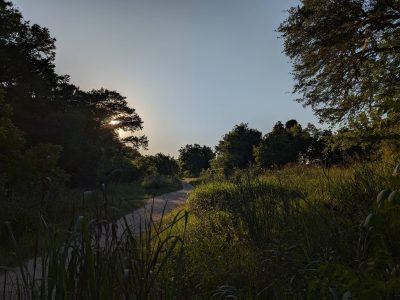
This firefly is a habitat generalist, typically found in open areas, although it has been observed in woodlands and near rivers and streams as well. More so than any other species of firefly, the big dipper firefly has been found in relatively disturbed habitats, including yards, county parks, cemeteries, orchards, fields, and along roadsides, highways, and railroads.
✕
Behavior
Activity Period
This species is seen flying from mid-June to early-July. However, their seasonality appears to be quite variable, arriving as early as mid-May and ending as late as late October in some years. Flash activity typically begins before and ends shortly after sunset, although small numbers can sometimes be seen as late as midnight.
Flash Pattern
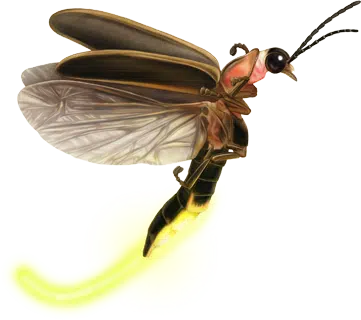
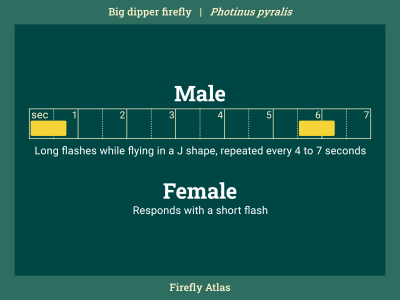
Displaying males emit long, yellow, J-shaped flashes every 4 to 7 seconds as they fly at waist height through open areas. Females respond by pointing their abdomen towards the male as they emit a single flash at a short delay.
✕
Sources
Faust, L.F. 2017. Fireflies, Glow-worms, and Lightning Bugs. Identification and Natural History of the Fireflies of the Eastern and Central United States and Canada. University of Georgia Press. Athens, GA. 356 pp.
Walker, A. 2021. Photinus pyralis. The IUCN Red List of Threatened Species 2021: e.T164046430A166771623. https://dx.doi.org/10.2305/IUCN.UK.2021-1.RLTS.T164046430A166771623.en. Accessed on 16 September 2025.
Walker, A. 2021. Photinus pyralis. NatureServe Explorer. Available at https://explorer.natureserve.org/Taxon/ELEMENT_GLOBAL.2.920094/Photinus_pyralis. Accessed on 16 September 2025.
Last Updated
Connect
Sign up for our newsletter to receive updates.
Follow
Follow the Xerces Society.
Share
Share this page.
Support
Support the Xerces Society's conservation work.
This is a project of the Xerces Society, working in collaboration with the IUCN SSC Firefly Specialist Group and New Mexico BioPark Society.