Spring tree-top flasher

Common Name

Spring tree-top flasher, northern firefly

Scientific Name

Pyractomena borealis

Recent Synonyms

None

Adult Male Size

14-22 mm

Diet

Unknown, but likely snails

Firefly Atlas Category

Common species

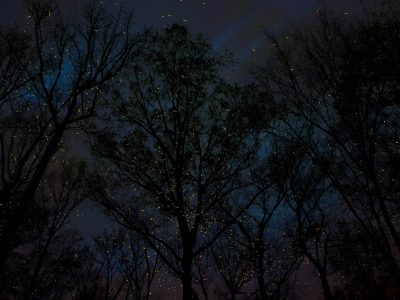
Spring tree-top flashers are widely distributed across the eastern US and Canada. Adults of this species are often the first flashing fireflies seen in the spring, emerging as early as March in some locations. Males give off a short, single amber flash every 2-3 seconds while flying high among the canopy of deciduous and mixed forests.

Identifying Features

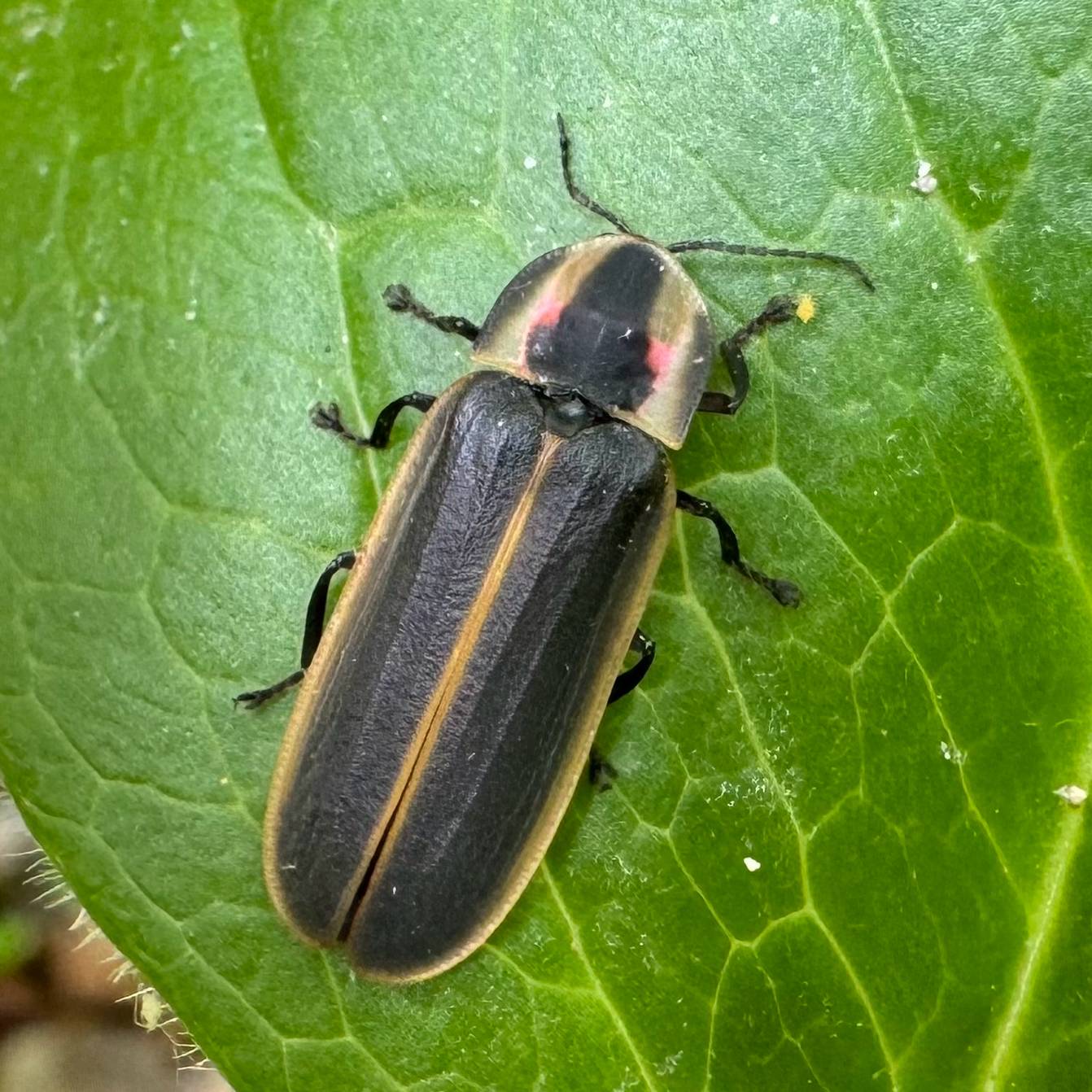
This species is relatively easy to identify given its early season appearance (typically the first flashing species of the year in many locations) and large size. Like other Pyractomena fireflies, spring treetop flashers have dark elytra (wing covers) bordered in yellow. Both males and females have lanterns.

Conservation

Status

IUCN Red List

The International Union for Conservation of Nature (IUCN) Red List of Threatened Species is an inventory of the global conservation status and extinction risk of biological species, maintained collectively by scientists worldwide.

Least Concern (LC)

NatureServe

The NatureServe conservation status ranks use a standardized methodology to assess the extinction risk of species, with a focus on the US and Canada. State wildlife agencies and natural heritage programs use these ranks to prioritize species for conservation actions.

Globally secure (G5) Vulnerable in Florida (S3) Apparently secure in West Virginia (S4) Apparently secure to secure in South Carolina, Alberta, Manitoba, Ontario, and Saskatchewan (S4S5) Secure in New Brunswick (S5) State/province not ranked in Alabama, Arkansas, Connecticut, Delaware, Georgia, Illinois, Indiana, Iowa, Kansas, Kentucky, Louisiana, Maine, Maryland, Massachusetts, Michigan, Minnesota, Mississippi, Missouri, New Hampshire, New Jersey, New York, North Carolina, Ohio, Oklahoma, Pennsylvania, Rhode Island, Tennessee, Texas, Vermont, Virginia, Wisconsin, and Quebec (SNR) Currently unrankable due to lack of information in Nova Scotia (SU)

Species of Greatest Conservation Need Lists

Species of Greatest Conservation Need (SGCN) are lists of species included in State Wildlife Action Plans, identifying animals and plants that need the most conservation attention and resources at the state and region level.

None

US Endangered Species Act

The Endangered Species Act is a United States law that provides legal protections to species that are officially listed as endangered or threatened by the US Fish and Wildlife Service.

N/A

Threats

Threats to the spring tree-top flasher include habitat degradation and light pollution.

Location

Distribution

USA

Alabama, Arkansas, Connecticut, Delaware, Florida, Georgia, Iowa, Illinois, Indiana, Kansas, Kentucky, Louisiana, Massachusetts, Maryland, Maine, Michigan, Minnesota, Missouri, Mississippi, North Carolina, New Hampshire, New Jersey, New York, Ohio, Oklahoma, Pennsylvania, Rhode Island, South Carolina, Tennessee, Texas, Virginia, Vermont, Wisconsin, West Virginia

Canada

Alberta, Manitoba, Nova Scotia, Ontario, Prince Edward Island, Quebec, Saskatchewan

Details

Spring tree-top flashers are widespread across the eastern US up to Alberta and the Maritime provinces of Canada.

Habitat

Spring tree-top flashers are found along the edges of fields and meadows and small openings in mixed deciduous forests. The species has an unusual life history, with an arboreal final larval instar that pupates on the sides of trees in late winter. Each successive generation may return to the same overwintering trees, preferentially selecting larger tulip poplars, hickories, and oaks with furrowed bark.

Behavior

Activity Period

Spring tree-top flashers are active in early spring, typically the first flashing fireflies to emerge in many locations. Flashing can begin as early as March and may continue through July in northern locations. Peak display is 45-90 minutes after sunset, although males have sometimes been observed flashing for much later than this.

Flash Pattern

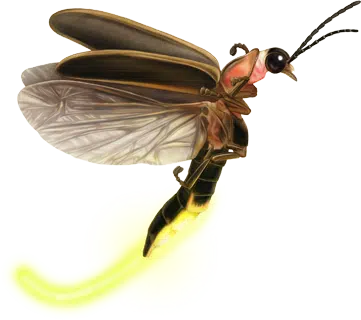
One short (quarter second) amber flash repeated every 2-3 seconds. Female responds with a long flash. Males flash while flying slowly, high in the tree canopy.

Sources

Faust, L.F. 2017. Fireflies, Glow-worms, and Lightning Bugs. Identification and Natural History of the Fireflies of the Eastern and Central United States and Canada. University of Georgia Press. Athens, GA. 356 pp. Walker, A. and S. Lewis. 2021. Pyractomena borealis. The IUCN Red List of Threatened Species 2021: e.T164044849A166771358. https://dx.doi.org/10.2305/IUCN.UK.2021-1.RLTS.T164044849A166771358.en. Accessed on 26 September 2025. Walker, A. and S. Lewis. 2021. Pyractomena borealis. NatureServe Explorer. https://explorer.natureserve.org/Taxon/ELEMENT_GLOBAL.2.747836/Pyractomena_borealis. Accessed on 26 September 2025.

Last Updated

Connect

Sign up for our newsletter to receive updates.

Follow

Follow the Xerces Society.

Share

Share this page.

Support

Support the Xerces Society's conservation work.

This is a project of the Xerces Society, working in collaboration with the IUCN SSC Firefly Specialist Group and New Mexico BioPark Society.

Copyright © 2026 The Xerces Society •1631 NE Broadway Street, #821 • Portland OR 97232 USA
Firefly logo by Ink Dwell studio; © 2020 Jane Kim