Common Name
Salt marsh firefly
Scientific Name
Photuris salina
Recent Synonyms
Photuris salinus
Adult Male Size
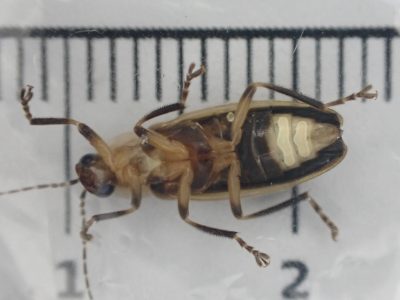
11 mm
Diet
Snails, slugs, worms, and other soft-bodied invertebrates
Firefly Atlas Category
Focal species
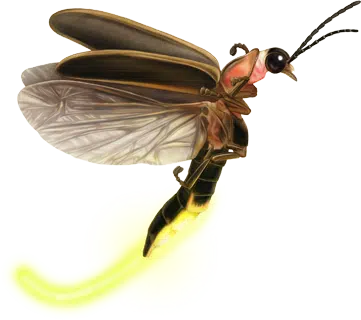
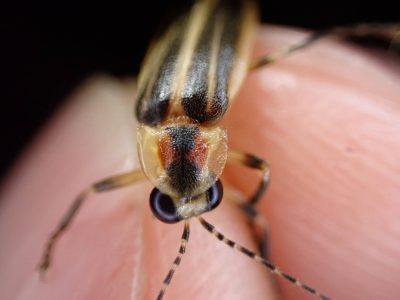
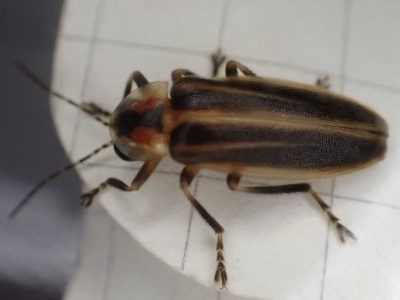
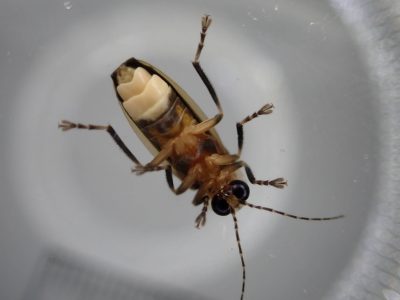
The salt marsh firefly is an uncommon species restricted to tidal marsh habitats along the Atlantic coast from New Jersey to Virginia. The main threat to this species is habitat degradation due to sea level rise, pesticide use, urban development, and the spread of the invasive common reed in coastal wetlands.
Conservation
Reason(s) For Firefly Atlas Focal Species Designation
Reliably identifiable, Suspected population loss
Status
IUCN Red List
The International Union for Conservation of Nature (IUCN) Red List of Threatened Species is an inventory of the global conservation status and extinction risk of biological species, maintained collectively by scientists worldwide.Near Threatened (NT)
NatureServe
The NatureServe conservation status ranks use a standardized methodology to assess the extinction risk of species, with a focus on the US and Canada. State wildlife agencies and natural heritage programs use these ranks to prioritize species for conservation actions.Globally vulnerable (G3) Vulnerable in Delaware (S3) Not yet assessed in Maryland or New Jersey (SNR)
Species of Greatest Conservation Need Lists
Species of Greatest Conservation Need (SGCN) are lists of species included in State Wildlife Action Plans, identifying animals and plants that need the most conservation attention and resources at the state and region level.Delaware
US Endangered Species Act
The Endangered Species Act is a United States law that provides legal protections to species that are officially listed as endangered or threatened by the US Fish and Wildlife Service.N/A
Threats
The primary threat to this species is habitat loss and degradation due to sea-level rise and storm surge associated with climate change, pesticide use, urban development, and the spread of the invasive plant, common reed (Phragmites australis), which can overtake this species’ marshy habitat and make it uninhabitable for fireflies. Some of the localities in Delaware may be extirpated due to these threats.
Location
Distribution
USA
Delaware, Maryland, New Jersey, Virginia
Details
The salt marsh firefly is a coastal species found along the Mid-Atlantic seaboard of the United States from New Jersey to Virginia.
Habitat
This species is generally found in windy coastal environments, within salt marshes and damp grass or rush-shrub brackish habitats.

Behavior
Activity Period
Adults are active May–July after dark.
Flash Pattern
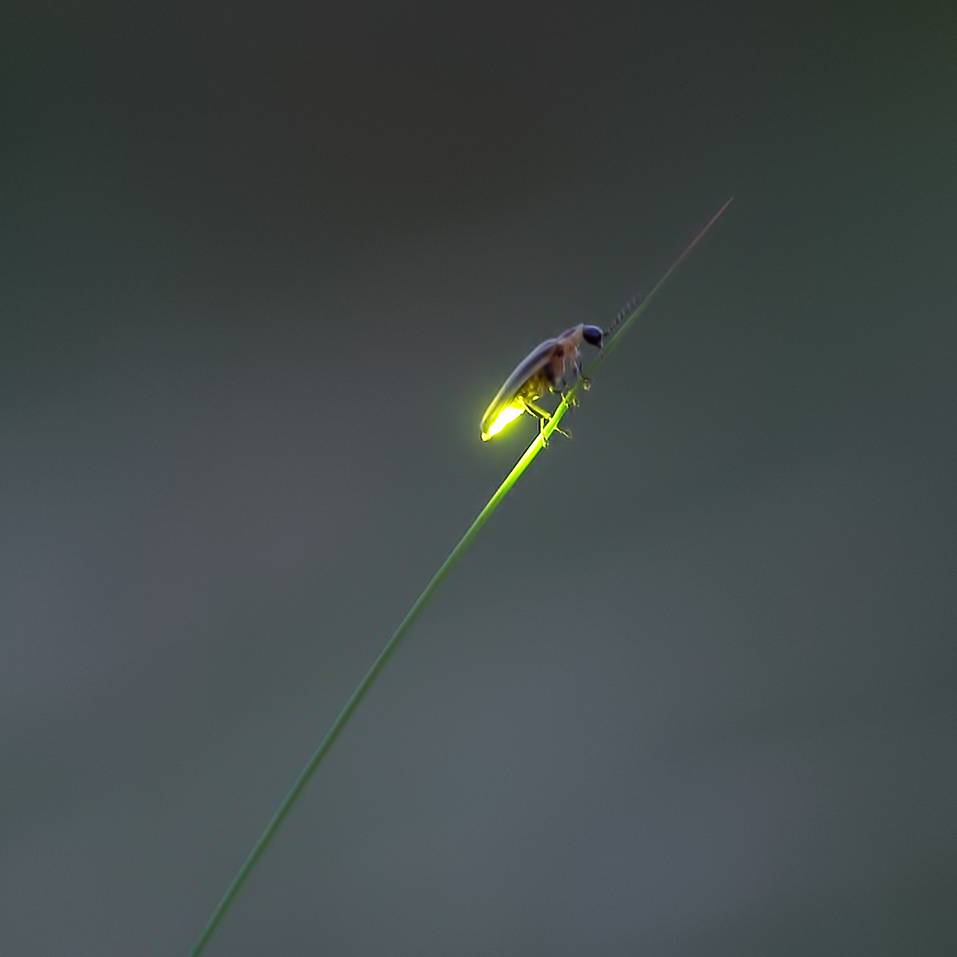
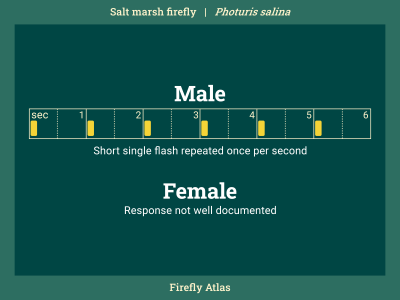
Males emit a single yellowish flash about once per second, sometimes in near synchrony with conspecific males, while flying just above the vegetation through the higher, drier margins of their salt marsh, or otherwise brackish, habitats.
Sources
Faust, L.F. 2017. Fireflies, Glow-worms, and Lightning Bugs. Identification and Natural History of the Fireflies of the Eastern and Central United States and Canada. University of Georgia Press. Athens, GA. 356 pp.
Heckscher, C. and A. Walker. 2021. Photuris salina. The IUCN Red List of Threatened Species 2021: e.T164045737A166771483. https://dx.doi.org/10.2305/IUCN.UK.2021-1.RLTS.T164045737A166771483.en. Accessed on 16 September 2025.
Heckscher, C. and A. Walker. 2021. Photuris salina. NatureServe Explorer. Available at https://explorer.natureserve.org/Taxon/ELEMENT_GLOBAL.2.737332/Photuris_salina. Accessed on 16 September 2025.