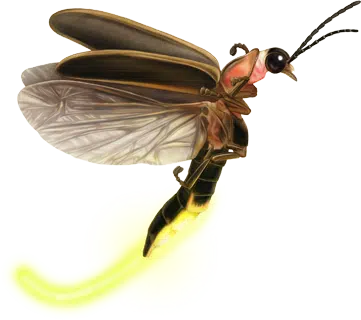
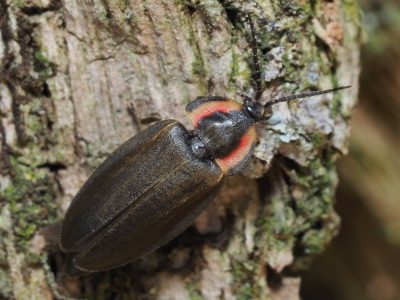
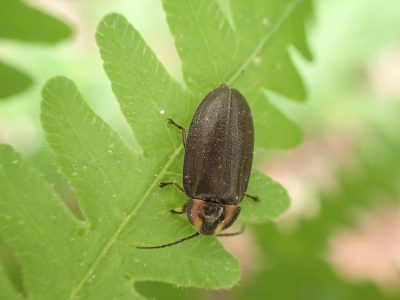
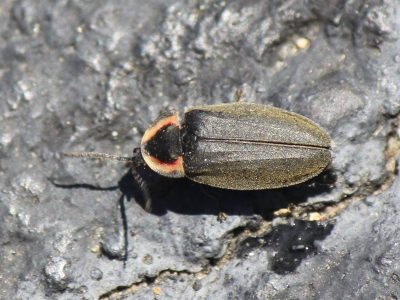
True to its name, the winter firefly is one of the first fireflies to emerge in the spring. Overwintering adults become active in March and can be found into May. This day active firefly lacks lanterns and instead uses chemical pheromones to attract mates. It is a common and widespread species found across much of central and eastern North America.
✕
Identifying Features
Medium to large day active firefly with no lanterns. Body is wide with ridged black elytra (wing covers). Pronotum (head shield) is marked by yellow and red parentheses surrounding a black central marking. The margins of the pronotum are black.
The NatureServe conservation status ranks use a standardized methodology to assess the extinction risk of species, with a focus on the US and Canada. State wildlife agencies and natural heritage programs use these ranks to prioritize species for conservation actions.
Globally secure (G5)
State rank not yet assessed in Alabama, Colorado, Connecticut, Georgia, Illinois, Indiana, Iowa, Kansas, Kentucky, Louisiana, Maine, Maryland, Massachusetts, Michigan, Minnesota, Missouri, Montana, New Hampshire, New Jersey, New Mexico, New York, North Carolina, North Dakota, Ohio, Pennsylvania, Rhode Island, Tennessee, Virginia, Wisconsin, and Wyoming (SNR)
State rank currently unavailable in Florida due to lack of information or substantially conflicting information about status or trends (SU)
Secure in West Virginia (S5)
Species of Greatest Conservation Need Lists
Species of Greatest Conservation Need (SGCN) are lists of species included in State Wildlife Action Plans, identifying animals and plants that need the most conservation attention and resources at the state and region level.
None
US Endangered Species Act
The Endangered Species Act is a United States law that provides legal protections to species that are officially listed as endangered or threatened by the US Fish and Wildlife Service.
N/A
Threats
Habitat loss and degradation, pesticide use, and climate change may all threaten this species. Because winter fireflies overwinter together in colony trees, they are especially vulnerable to threats to those trees, including natural tree mortality due to high winds, disease, or lightning.
Location
Distribution
USA
Alabama, Colorado, Connecticut, Florida, Georgia, Iowa, Illinois, Indiana, Kansas, Kentucky, Louisiana, Massachusetts, Maryland, Maine, Michigan, Minnesota, Missouri, Montana, North Carolina, North Dakota, New Hampshire, New Jersey, New Mexico, New York, Ohio, Pennsylvania, Rhode Island, Tennessee, Virginia, Vermont, Wisconsin, West Virginia
Canada
Alberta, British Columbia, Manitoba, New Brunswick, Newfoundland and Labrador, Nova Scotia, Northwest Territories, Ontario, Quebec, Prince Edward Island, Yukon, Saskatchewan
Mexico
Details
The winter firefly is widespread across eastern North America, spanning Canada, the US, and Mexico, from the Rocky Mountains in the west to the Atlantic coast in the east. Although numerous records labelled as this species exist west of the Continental Divide, these probably represent other species of western diurnal Photinus and not this species.
Habitat
The winter firefly can be found in a wide variety of habitat types, including hardwood, coniferous, and mixed forests, along streams, rivers, and ponds, in orchards and agricultural fields, wet meadows, along seashores in salt marshes, and in yards and open parks.
Behavior
Activity Period
Unlike many other firefly species, the winter firefly overwinters in the adult stage, and is able to withstand freezing temperatures during this time. Adults become active once temperatures begin to warm up in spring. Because of its tolerance for cold weather, the winter firefly is often among the first fireflies seen each year. The typical breeding season for this species tends to be mid-March through mid-May.
Flash Pattern
This species does not use bioluminescent light in courtship, but instead relies on pheromones to communicate with potential mates.
Sources
Fallon, C. 2021. Ellychnia corrusca. The IUCN Red List of Threatened Species 2021: e.T164013862A166771263. https://dx.doi.org/10.2305/IUCN.UK.2021-1.RLTS.T164013862A166771263.en. Accessed on 16 September 2025.
Fallon, C. 2021. Photinus corruscus. NatureServe Explorer. Available at https://explorer.natureserve.org/Taxon/ELEMENT_GLOBAL.2.746911/Photinus_corruscus. Accessed on 16 September 2025.
Faust, L.F. 2017. Fireflies, Glow-worms, and Lightning Bugs. Identification and Natural History of the Fireflies of the Eastern and Central United States and Canada. University of Georgia Press. Athens, GA. 356 pp.
Last Updated
Connect
Sign up for our newsletter to receive updates.
Follow
Follow the Xerces Society.
Share
Share this page.
Support
Support the Xerces Society's conservation work.
This is a project of the Xerces Society, working in collaboration with the IUCN SSC Firefly Specialist Group and New Mexico BioPark Society.