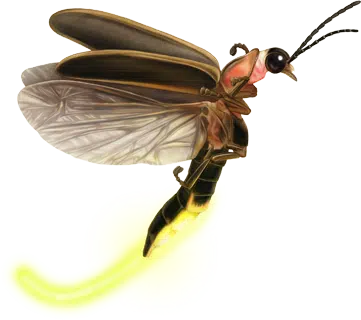
Marsh flicker

Common Name

Marsh flicker, wiggle dancer

Scientific Name

Pyractomena dispersa

Recent Synonyms

None

Adult Male Size

7.4-14 mm

Diet

Unknown, but likely snails and other invertebrates

Firefly Atlas Category

Common species

The marsh flicker is a widespread species with a patchy distribution across much of the United States. It is likely that eastern and western populations represent two separate species. This firefly is associated with wet meadows and open marshy habitats, often with cattails. Adults are active in the spring, with males giving off short, orange-yellow flickering flashes every 3-5 seconds.
  • A close-up image of a marsh flicker against a white background.
  • A close-up image of a marsh flicker against a white background.
  • A close-up image of a marsh flicker against a white background.
  • A close-up image of the underside of a female marsh flicker against a white background.

Identifying Features

Like all Pyractomena, this firefly has the characteristic ridge or keel on its head shield (pronotum). The edges of the head shield typically lack any black borders, although populations in the West can have slightly darker edges. Elytra (wing covers) are edged in yellow, as is the black scutellum (although not always).

Conservation

Status

IUCN Red List

The International Union for Conservation of Nature (IUCN) Red List of Threatened Species is an inventory of the global conservation status and extinction risk of biological species, maintained collectively by scientists worldwide.

Data Deficient (DD)

NatureServe

The NatureServe conservation status ranks use a standardized methodology to assess the extinction risk of species, with a focus on the US and Canada. State wildlife agencies and natural heritage programs use these ranks to prioritize species for conservation actions.

Globally currently unrankable due to lack of information or substantially conflicting information about status or trends (GU) State not ranked in Alabama, Arizona, Arkansas, Colorado, Connecticut, Delaware, Georgia, Idaho, Kentucky, Maine, Maryland, Massachusetts, Michigan, Mississippi, Missouri, Montana, New Hampshire, New Jersey, New York, North Dakota, Ohio, Oklahoma, Pennsylvania, Rhode Island, Tennessee, Utah, Vermont, Virginia, Washington (SNR) Vulnerable in West Virginia (S3) Apparently secure to secure in Alberta and Saskatchewan (S4S5) Unrankable in Manitoba (SU)

Species of Greatest Conservation Need Lists

Species of Greatest Conservation Need (SGCN) are lists of species included in State Wildlife Action Plans, identifying animals and plants that need the most conservation attention and resources at the state and region level.

None

US Endangered Species Act

The Endangered Species Act is a United States law that provides legal protections to species that are officially listed as endangered or threatened by the US Fish and Wildlife Service.

N/A

Threats

There is some evidence of local extirpations in several different regions throughout this species' range. Declines are likely the result of habitat loss due to development, conversion of land for agricultural, and light pollution.

Location

Distribution

USA

Alabama, Arkansas, Arizona, Colorado, Connecticut, Delaware, Georgia, Idaho, Kentucky, Massachusetts, Maryland, Maine, Michigan, Missouri, Mississippi, North Carolina, North Dakota, New Hampshire, New Jersey, Nevada, New York, Ohio, Oklahoma, Pennsylvania, Tennessee, Utah, Virginia, Vermont, Washington, West Virginia

Canada

Alberta, Manitoba, Saskatchewan

Details

The marsh flicker is widely distributed across the US and Canada, from eastern Alberta south to Arizona in the West and from Maine to Georgia in the East. It has a patchy distribution, with eastern and western populations being largely disjunct from one another.

Habitat

Marsh flickers are found in wet habitats including swamps, marshes, river sloughs, fields, and meadows. In the West, this species can occur at elevations above 6,000 feet.
  • Vibrant green meadows in front of dry hills under a blue sky.
  • A grassy meadow at dusk. Tall conifers line the background. Most of the grass is dried out except for a few green patches.
  • A creek surrounded on both sides by bulrush and nettles. Dry hills stretch across the horizon under a blue sky.

Behavior

Activity Period

At lower latitudes, adults of this species are active in the spring, beginning in April, but at higher latitudes and altitudes, adults are active from late June to early July. Courtship displays begin about 35 minutes after sunset.

Flash Pattern

Males fly low over vegetation giving off short, yellow-orange flicker-flashes that are repeated every three to five seconds.
  • Flash pattern diagram depicting the male flash of the marsh flicker firefly. Female response flash is not well documented.
  • A triplet of amber flashes flare out against a darkened silhouette of trees and a hillside. A starry night sky is overhead.

Sources

Faust, L.F. 2017. Fireflies, Glow-worms, and Lightning Bugs. Identification and Natural History of the Fireflies of the Eastern and Central United States and Canada. University of Georgia Press. Athens, GA. 356 pp. Walker, A. 2021. Pyractomena dispersa. The IUCN Red List of Threatened Species 2021: e.T164044858A166771363. https://dx.doi.org/10.2305/IUCN.UK.2021-1.RLTS.T164044858A166771363.en. Accessed on 02 October 2025. Walker, A. 2021. Pyractomena dispersa. NatureServe Explorer. https://explorer.natureserve.org/Taxon/ELEMENT_GLOBAL.2.808607/Pyractomena_dispersa. Accessed on 02 October 2025.

Last Updated

Connect

Sign up for our newsletter to receive updates.

Follow

Follow the Xerces Society.

Share

Share this page.

Support

Support the Xerces Society's conservation work.

This is a project of the Xerces Society, working in collaboration with the IUCN SSC Firefly Specialist Group and New Mexico BioPark Society.

Copyright © 2026 The Xerces Society •1631 NE Broadway Street, #821 • Portland OR 97232 USA
Firefly logo by Ink Dwell studio; © 2020 Jane Kim