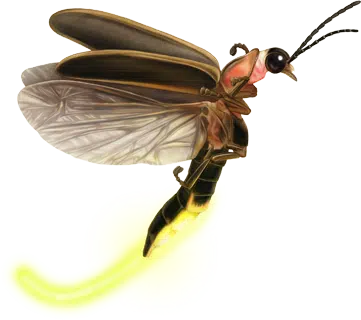

Common Name
Highlands Hammock treetop flasher
Scientific Name
Pyractomena limbicollis
Recent Synonyms
None
Adult Male Size
7-12 mm
Diet
Snails
Firefly Atlas Category
Lost species
This species may be endemic to Florida, although there are a couple potential records from Georgia and South Carolina. This species flies in the spring, with adults seen performing courtship displays in a variety of hammock and pine flatwood habitats. The main threats to this species are habitat degradation, drought, and artificial light at night. It appears to be rare, but this may be because adults flash high up in the trees, where they may be overlooked. The species can also be difficult to identify from afar, as they do not always have an easily recognizable flash pattern. It was last reliably documented in an urban park in Gainesville, Florida, in 1983.
Conservation
Status
IUCN Red List
The International Union for Conservation of Nature (IUCN) Red List of Threatened Species is an inventory of the global conservation status and extinction risk of biological species, maintained collectively by scientists worldwide.Data Deficient (DD)
NatureServe
The NatureServe conservation status ranks use a standardized methodology to assess the extinction risk of species, with a focus on the US and Canada. State wildlife agencies and natural heritage programs use these ranks to prioritize species for conservation actions.Globally unrankable due to lack of information (GU) Vulnerable in Florida (S3)
Species of Greatest Conservation Need Lists
Species of Greatest Conservation Need (SGCN) are lists of species included in State Wildlife Action Plans, identifying animals and plants that need the most conservation attention and resources at the state and region level.None
US Endangered Species Act
The Endangered Species Act is a United States law that provides legal protections to species that are officially listed as endangered or threatened by the US Fish and Wildlife Service.N/A
Threats
Threats to this species are not well documented, but likely include habitat degradation (due to burning grasses and understory vegetation in plantation flatwoods, which can affect arboreal larvae and pupae), drought, and artificial light at night.
Location
Distribution
USA
Florida
Details
This firefly has been found in a number of locations across Florida, including Highlands Hammock State Park (the type locality), Lloyd’s study site at Possum Creek (now within Loblolly Woods Nature Park) in Gainesville, and Everglades National Park (near Royal Palm visitor center).
Habitat
This species has been found in a variety of forested habitats including pine flatwoods, swamp forests, hydric hammocks, areas adjacent to mesic hammocks, gallery pines along highways, and in a gallery of hardwoods next to pond cypress along a lake.
Behavior
Activity Period
Adults are active from February through April, performing courtship displays high up in the treetops in a variety of hammock and pine flatwood habitats. Larvae are arboreal and can be seen climbing up trees on rainy days in October and November.
Flash Pattern
Males produce a single short flash, rarely followed by a second slightly dimmer flash.
Sources
Lloyd, J. E. 2018. A naturalist’s long walk among shadows: of North American Photuris – patterns, outlines, silhouettes… echoes. Self-published, Gainesville, FL, USA. 477 pp.
Walker, A. 2021. Pyractomena limbicollis. The IUCN Red List of Threatened Species 2021: e.T164044912A166771378. https://dx.doi.org/10.2305/IUCN.UK.2021-1.RLTS.T164044912A166771378.en. Accessed on 26 March 2026.
Walker, A. 2021. Pyractomena limbicollis: a firefly. NatureServe Explorer. https://explorer.natureserve.org/Taxon/ELEMENT_GLOBAL.2.1215531/Pyractomena_limbicollis. Accessed on 26 March 2026.