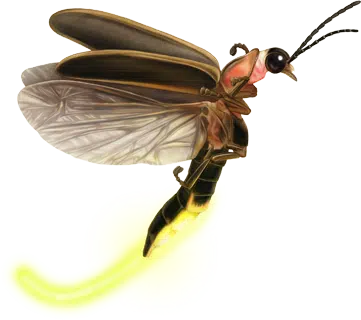

Common Name
Florida-candle firefly, Barber's spring firefly
Scientific Name
Pyractomena barberi
Recent Synonyms
None
Adult Male Size
11-12.75 mm
Diet
Snails
Firefly Atlas Category
Lost species
The Florida-candle firefly is a narrowly distributed species endemic to Florida. It has a disjunct distribution, with reported occurrences in the counties of Dixie, Lafayette, Levy, and Wakulla in the north, and Miami-Dade in the south. In the northern portion of its range, it has been observed in wet prairie and pine flatwood forest habitats of the Gulf Hammock region. This species is quite rare, and historically was only found in a few localities, albeit often in abundance. However, it has not been reliably reported since the 1960s. Threats to this species include drought and late winter burning of commercial pine forests, which may burn or desiccate pupae within the vegetation.

Conservation
Status
IUCN Red List
The International Union for Conservation of Nature (IUCN) Red List of Threatened Species is an inventory of the global conservation status and extinction risk of biological species, maintained collectively by scientists worldwide.N/A
NatureServe
The NatureServe conservation status ranks use a standardized methodology to assess the extinction risk of species, with a focus on the US and Canada. State wildlife agencies and natural heritage programs use these ranks to prioritize species for conservation actions.Globally unrankable due to lack of information (GU) Imperiled to vulnerable in Florida (S2S3)
Species of Greatest Conservation Need Lists
Species of Greatest Conservation Need (SGCN) are lists of species included in State Wildlife Action Plans, identifying animals and plants that need the most conservation attention and resources at the state and region level.None
US Endangered Species Act
The Endangered Species Act is a United States law that provides legal protections to species that are officially listed as endangered or threatened by the US Fish and Wildlife Service.N/A
Threats
This species is quite rare, and historically was only found in a few localities, albeit often in abundance. However, now it is unclear whether it has been observed recently, and declines have been reported in some areas, including the Mallory Swamp region. Possible reasons for decline probably include drought and late winter burning of commercial pine forests, which may burn or desiccate pupae within the vegetation. The lack of recent records may be due in part to lack of sampling effort and difficulty in noticing this early spring species.
Location
Distribution
USA
Florida
Details
The Florida-candle firefly is a narrowly distributed species endemic to Florida. It has a disjunct distribution, with reported occurrences in the Big Bend region of northern Florida (Dixie, Lafayette, Levy, and Wakulla Counties) and Miami-Dade County in southern Florida. Documented localities for this species include Yankee Town, Austin Cary Forest, Archbold Biological Station, Hillsborough River State Park, and Little Manatee River, U.S. Hwy. 41.
Habitat
This species is associated with wet prairies, pine flatwoods, and possibly other wetland types.
Behavior
Activity Period
Courtship begins in late winter or very early spring and extends from mid-February to mid-April. Males begin flashing in full darkness, about 40 minutes after sunset.
Flash Pattern
Males fly several meters above grassy vegetation, producing short orange-yellow flickers, each consisting of five to nine modulations, repeated about every two seconds.
Sources
Lloyd, J. E. 2018. A naturalist’s long walk among shadows: of North American Photuris – patterns, outlines, silhouettes… echoes. Self-published, Gainesville, FL, USA. 477 pp.
Walker, A. 2021. Pyractomena barberi. The IUCN Red List of Threatened Species 2021: e.T164044845A166771353. https://dx.doi.org/10.2305/IUCN.UK.2021-1.RLTS.T164044845A166771353.en. Accessed on 26 March 2026.
Walker, A., and R.L. Gundy. 2025. Pyractomena limbicollis: Florida-Candle Firefly. NatureServe Explorer. https://explorer.natureserve.org/Taxon/ELEMENT_GLOBAL.2.1215528/Pyractomena_barberi. Accessed on 26 March 2026.