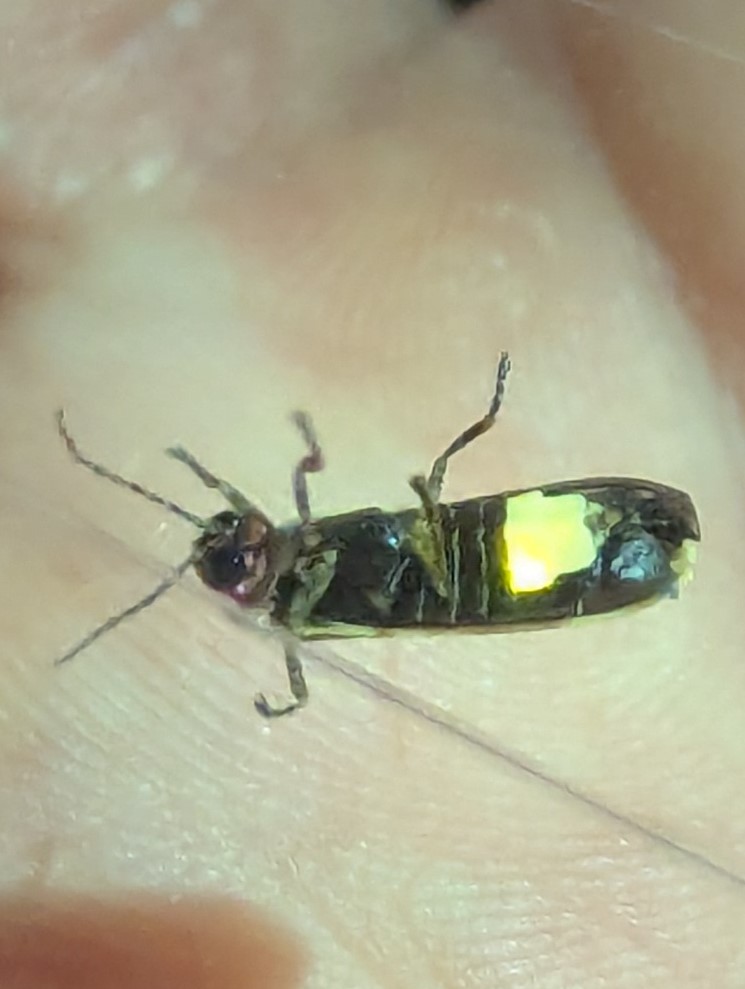
Observation: Photinus ignitus
Primary Observer:
Carl Manthey
Event Date:
2025-06-07
Status:
Unverified


Survey
Site Name:
Great Marsh, Elverson, PA
Province/State:
Pennsylvania
Event Date:
2025-06-07
Time of Day:
Night-Time
Start Time:
20:30
End Time:
22:00
Number of Observers:
5
Primary Observer:
Carl Manthey
Additional Observers:
Myrna Villanueva, Bernard Brown, Diana Cormack, Kathy Varady
target_species_genus:
unknown
target_species_species:
unknown
Location and Habitat
Location Accuracy (meters):
500-1000
Habitat Type:
Open Freshwater Wetland - Wetland Bog, fen, freshwater marsh
Habitat Type Notes:
 
Elevation (meters):
150 - 200
Area Searched (hectares):
8
Artificial Light Sources
Vehicles: No
Street Lights: No
Buildings: No
Street Lights: No
Buildings: No
Artificial Light Types
Sky Glow (diffuse illumination in the sky): No
Light Trespass (light cast on surfaces beyond its intended target): No
Glare (bright light causing visual discomfort): No
Light Trespass (light cast on surfaces beyond its intended target): No
Glare (bright light causing visual discomfort): No
Artificial Light Notes:
 
Observation
Observation Type:
With Flash Data
Number Observed:
2-10
genus:
photinus
Species:
ignitus
Observation Notes:
In among trees around the catfish pond and marsh.
Specimen Voucher Number:
Flash Behavior
First Flash Time:
21:20
Last Flash Time:
21:55
First Flash Temp (F):
70
Last Flash Temp (F):
69
Flashes in Pattern:
1
Flash Color:
Yellow
Flash Pattern Period:
4
Flash Duration:
<0.5
Flash Interval:
4
Male Height Zone:
High (over 8 ft)
Flash Location:
In tree canopy along catfish pond and marsh.
Male Flash Behavior:
One short flash every 4 seconds. Could this be P. ignitus?
Female Flash Behavior:
 
1 thought on “Observation: Photinus ignitus”
Leave a Comment
You must be logged in to post a comment.


Based on the single flash with a flash pattern period of 4 seconds at 70 degrees, the dark pygidium, and dark color of ventrite 4 (the segment just before the lanterns), Photinus ignitus does seem likely. Closer views showing the shape of the pygidium and the coloration of the scutellum would be helpful. (The scutellum is usually dark with a pale tip in Photinus ignitus.)